|
|
|
|
Munir is an artist committed to the world he lives in and is engaged
with the human feature. He offers us a work distinguished by a
concept based on abstraction that reflects existential grief,
alienation, agony, and the struggle of the human being in his
environment.
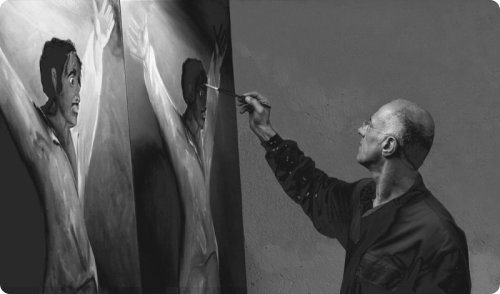
Munir uses different techniques and bases in his work,
preferring the acrylic painting, applying it on canvas, paper and
carton. He uses the collage as well through mixing painting with
black and white photographs characterized by influential social
content. We can not ignore his graphics which, as the rest of his
works, embody the interpenetration of art and feelings. Munir's
paintings come into our view in the form of dual paintings where two
entirely different worlds conflict.
In the first we see a
documentary black and white world expressing an intensive sense of
solitude. In the second we see a powerful movement shaping a number
of figures, lines, circles and unfinished strokes. And we hear
Munir's cry through the silent symbols embodied by the strokes of a
single, but strong brush, prevailing in the art work and composed of
intensive colours contrasting and balancing with the former
conviction, reaching us through twisting forms that sometimes
manifest in a violent manner that reveal frustration. Thus we find
ourselves facing an aesthetic expression of the feelings of an
artist who lets us enter his inner world sharing his anxiety and
anger at injustice. Here Munir provoke us through his questions and
symbols, moving us towards contradiction. How can we find beauty
within this flow of concerns? The artist manages to influence us and
we discover his creativity through his colours and strokes that are
angrily manifested on solid bases. These bases appear as if they
were boundaries that can not be penetrated and they symbolise the
human powerlessness in the face of the horror surrounding the human
being. These art works are the wall against which we throw our whole
anger.
Munir's works invite us to inner contemplation and keep us
away from indifference and apathy. Thus he introduces art as a
component of Meditation and rebellion.
|
|
|
|
|
|
